BADMINTON RACKET REVIEW
Yonex Arcsaber 11 Pro Player Review: Control, Smash & Back-Court Test
A control-first look at the Arcsaber 11 Pro: how its stiff, stable design fits smash placement, back-court construction, drives, defence and net play.
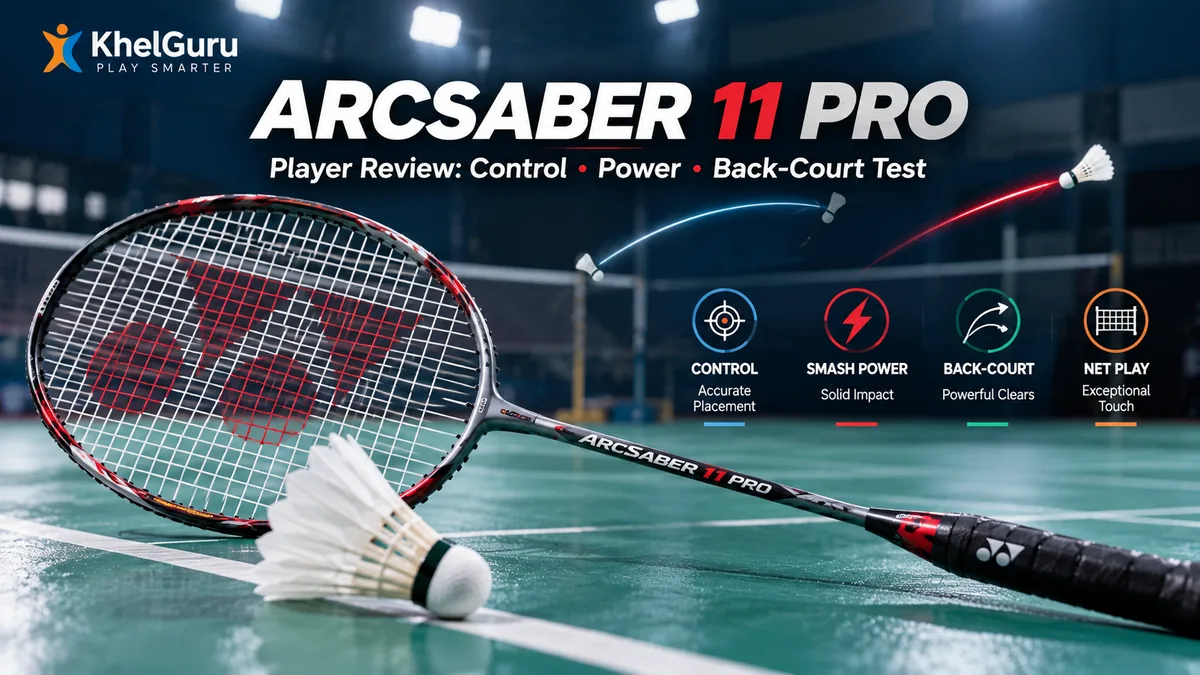
A control-first look at the Arcsaber 11 Pro: how its stiff, stable design fits smash placement, back-court construction, drives, defence and net play.
| Flex | Stiff |
|---|---|
| Frame | HM Graphite + POCKETING BOOSTER |
| Shaft | HM Graphite + SUPER HMG + Ultra PE Fiber |
| Joint | New Built-in T-Joint, T-ANCHOR |
| Length | 10 mm longer |
| Weight / grip | 4U (Avg. 83 g) G5,6; 3U (Avg. 88 g) G4,5,6 |
| Stringing advice | 4U: 19–27 lbs; 3U: 20–28 lbs |
| Colour | Grayish Pearl |
| Made in | Japan |
These details are supported by Yonex’s current 2026 catalogue and ARCSABER documentation. Grip availability and stocked weight versions can differ by region, so verify the exact racket before purchase.
Yonex built this generation around what it calls “decisive control”. The top and bottom of the frame are designed for stability while the sides flex more around the sweet spot. The CONTROL-ASSIST BUMPER with T-ANCHOR is intended to reduce unwanted string movement, while POCKETING BOOSTER adds elasticity around impact.
Yonex reported increased shuttle-contact time and smash power versus the previous Arcsaber 11 in its own development testing. Those numbers are manufacturer test results, not independent KhelGuru measurements, so this review uses them only as design context.
Control is where the Arcsaber concept makes the most sense. The stiff shaft and stable face suit deliberate changes of direction: straight-to-cross drives, blocks into open space, controlled pushes and half-smashes. The racket is more about making your existing swing predictable than masking poor timing with extra flex.
In fast exchanges, the useful quality is the combination of compact preparation and directional confidence. For a player who likes to hold the shuttle, show one shot and play another, or counter-attack into gaps, the design is particularly relevant.
The Arcsaber 11 Pro should not be treated as an Astrox-style power specialist. Its stiff response rewards a committed swing and clean timing. With good acceleration, the stable face and extra 10 mm length give a solid platform for steep, accurately directed attacking shots.
The more interesting advantage is smash placement: body attack, channel attack and changing direction without needing a very head-heavy feel. Players wanting maximum easy rear-court weight may prefer a more power-oriented setup. For that comparison, see our Yonex Astrox 100 ZZ VA review.
From the rear third, the test is not one maximum clear. A useful racket must repeat length, change pace and let the player disguise clear, drop and attacking strokes. The stiff shaft means technique matters: players with adequate swing speed can exploit the stable face for accurate deep clears and controlled drops, while players relying heavily on shaft flex may find the PRO more demanding when late to the shuttle.
To examine your own racket-head movement rather than guessing, read KhelGuru’s guide on measuring badminton racket swing speed from video.
Tight net shots, holds, pushes and late direction changes fit the racket’s control-first design. The stable response is useful when the stroke is short and precision matters more than raw acceleration.
For many players, 4U will be easier to move quickly in defence, while 3U adds mass but asks more from the arm during rapid exchanges. This is a general weight-class trade-off, not a guarantee; strings, grip build-up and individual technique can materially change the final feel.
Yonex originally listed NBG95 for hard hitters and BG66 Ultimax for control-oriented players for this model. Tension also changes the response: higher tension can feel more direct but less forgiving, while an appropriate lower tension can make clean length easier. Stay within Yonex’s advice for your exact weight version.
Shuttle type matters too. Our nylon vs feather shuttlecock guide explains why timing and feel can change when the shuttle changes.
It is most logical for an intermediate-to-advanced player who already generates racket-head speed and wants precision, stable contact and a control-first response. It particularly suits players who enjoy drives, placement, counter-attacks, holds and changes of pace rather than depending only on head-heavy momentum.
A developing player should not choose it merely because it carries the PRO name. Start with your technique, preferred weight and playing style. Our badminton racket selection guide covers those factors, while KhelGuru AI can help narrow the racket profile that suits you.
The Arcsaber 11 Pro remains distinctive because it does not try to solve every rally with more head weight. Its appeal is the combination of stiff response, frame stability and Yonex’s shuttle-hold concept. For the right player, that supports confidence when placing the shuttle under pressure.
The trade-off is equally clear: a stiff control racket expects the player to contribute technique and acceleration. If you want the racket to create easy power for you, there are more forgiving choices. If you already create pace and care about where that pace goes, the Arcsaber 11 Pro is much closer to its intended role.
It can produce strong attacks, but Yonex positions ARCSABER around control and shuttle hold rather than a purely head-heavy power identity.
Neither is universally better. 4U is lighter and often easier in fast exchanges; 3U adds mass. Strength, timing, singles/doubles use and personal preference matter.
Its drives, placement and counter-attacking characteristics can suit doubles if the stiff response matches the player. Yonex also documents international doubles players using the model.
The 2026 Yonex catalogue lists 19–27 lbs for 4U and 20–28 lbs for 3U. Always verify the exact racket before stringing.
Subham Sarkar is a traveller, athlete, sports writer and equipment reviewer at KhelGuru. He writes practical sports guides and equipment reviews with the player’s point of view in mind.
Comments
Have you used the Arcsaber 11 Pro? Share your experience. Comments are moderated before publication.