Yonex Nylon vs Feather Shuttlecock: Which Should You Choose?
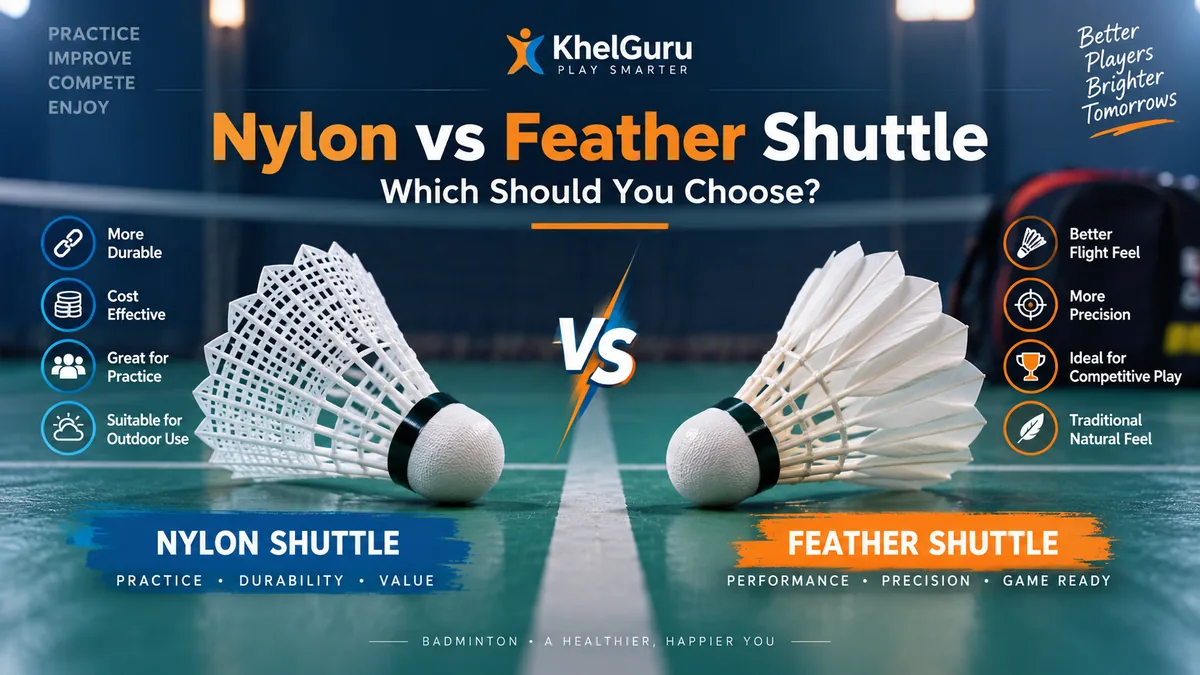
Nylon and feather shuttlecocks serve different priorities. Nylon is practical for repeated practice and durability; feather is the traditional choice when players want the flight, recovery and feel associated with competitive badminton.
Nylon vs feather: choose according to player level, training purpose, conditions and durability needs.
Quick answer: For beginners, coaching batches and high-volume practice, a Yonex MAVIS nylon shuttle is usually the practical choice because it prioritises durability and repeat use. For advanced training, match simulation and competitive play, a quality feather shuttle such as Yonex AEROSENSA gives the traditional feather construction and flight behaviour players expect. Temperature, altitude and the exact model also affect shuttle speed.
Yonex nylon vs feather shuttle: main differences
Factor
Nylon
Feather
Construction
Moulded synthetic nylon skirt in MAVIS models.
Natural feathers around a cork base; current AEROSENSA 20/30/40 specifications list goose feathers and solid cork.
Durability
Designed for repeated practice; generally survives more rallies.
Individual feathers can wear or break, changing flight sooner.
Flight
Yonex designs MAVIS for close-to-feather flight while prioritising durability.
Natural feather remains the traditional reference for competitive shuttle flight and deceleration.
Typical use
Beginners, coaching, recreational play and high-volume drills.
Advanced training, match simulation and competition.
Running cost
Usually lower for repeated practice because replacement is less frequent.
Usually higher because damaged feathers can require earlier replacement.
Yonex MAVIS nylon shuttles: where they make sense
Yonex positions the MAVIS series as a durable practice solution designed to approach feather shuttle flight. Current official MAVIS 300 information lists a natural cork base and Slow, Medium and Fast versions, while MAVIS 350 is described by Yonex as a nylon shuttle intended to combine stable flight with long-lasting performance.
Nylon is especially useful for schools, academies, beginner groups and repetitive feeding drills. When hundreds of contacts are required, the extra useful life can matter more than reproducing tournament conditions on every rally.
Do not treat every MAVIS model as identical. Available speed grades, construction details, colours and market availability can differ by model and region.
Yonex feather shuttles: AEROSENSA and match-oriented play
Yonex AEROSENSA feather shuttles use natural feather construction. Current official AEROSENSA 20, 30 and 40 specifications list solid cork and goose feathers. Yonex describes the range around stability, trajectory, recovery, speed and distance.
Feather becomes particularly important when a player is preparing for competition. Touch at the net, slices, fast exchanges and the way a shuttle slows after a hard shot all influence timing. Training with the shuttle type expected in competition reduces the gap between practice and match conditions.
What defines a quality feather shuttlecock?
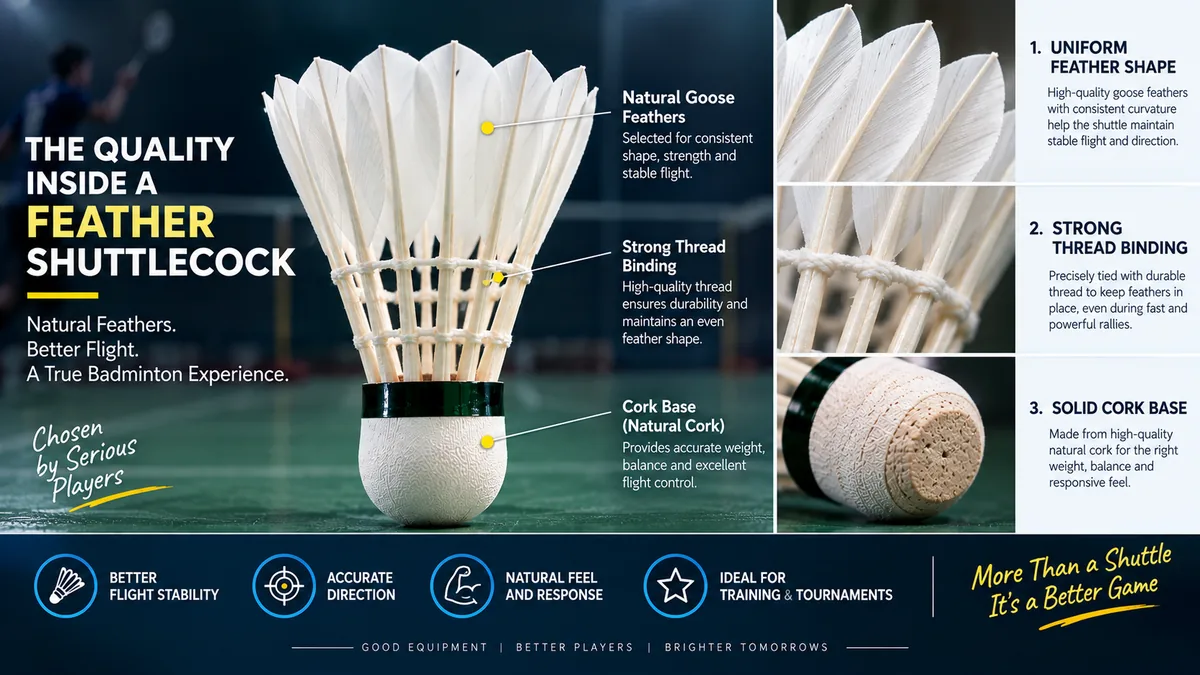
A quality feather shuttlecock depends on more than the feather material alone. Uniform feather shape, secure thread binding and a well-made cork base all contribute to stable flight, predictable direction and a consistent response. Once feathers become badly bent, frayed or broken, flight can become less consistent.
Feather shuttlecock quality reference: consistent feathers, secure binding and a solid cork base are important construction features. This is a general feather-shuttle illustration, not a Yonex-branded product image.
Which player should use which shuttle?
Beginners and recreational players
Nylon is usually the sensible starting point. It allows longer practice with fewer replacements while players concentrate on contact, movement and technique.
Club and improving players
A mixed approach works well: use nylon for high-volume drills where durability matters, then use feather regularly for tactical work and match preparation if your competitions use feather.
Advanced and competitive players
Feather is generally more appropriate for match-specific practice and competition. The goal at this level is not only durability; training should reproduce the flight behaviour expected in the event.
Speed and temperature: an important specification
For MAVIS 300, Yonex currently lists Green Cap / Slow for 22°C–33°C, Blue Cap / Medium for 12°C–23°C and Red Cap / Fast for 0°C–13°C. Not every MAVIS model is offered in every speed.
Yonex feather shuttles use numbered temperature grades. Current official references list Grade 1 for 33°C and above, Grade 2 for 27°C–33°C, Grade 3 for 22°C–28°C and Grade 4 for 17°C–23°C, with Grade 5 for colder conditions. Yonex also notes that altitude can affect shuttle performance.
For Indian players, this is worth checking because court conditions vary greatly by season and location. Choose the speed grade for the exact shuttle and your playing environment rather than assuming one speed is suitable all year.
There is now a third category: synthetic feather
In 2026 Yonex introduced CROSSWIND 70, a high-performance synthetic feather shuttle. Yonex says it uses a porous nylon wing, a nylon/carbon-graphite stem and natural cork, and was developed for consistent flight and reliable durability. Yonex positions it as a tournament-grade option alongside traditional feather shuttlecocks, with limited availability in selected markets from 2026.
Practical selection checklist
High-volume coaching or drills: choose nylon for durability.
Beginner learning technique: nylon is economical and practical.
Preparing for feather-shuttle matches: include feather regularly in training.
Advanced net play, slices and match simulation: feather better reproduces traditional match conditions.
Hot/cold conditions: check the exact shuttle's speed or temperature grade.
High altitude: test locally because altitude can alter shuttle performance.
Common mistake: choosing only by price
The cheapest tube is not automatically the lowest-cost training choice, and the most expensive feather shuttle is not necessary for every drill. Match the shuttle to the purpose of the session. Nylon can be efficient for repetitive feeding; feather can justify its higher consumption when realistic match flight is the training objective.
It is often more practical because durability and lower replacement frequency suit repeated practice. Players preparing for feather-shuttle competition should gradually include feather in training.
Why do advanced players use feather?
Feather provides the traditional flight and deceleration behaviour associated with competitive badminton, making it useful for match-specific preparation.
Does MAVIS fly exactly like feather?
No synthetic shuttle should be assumed to reproduce every natural-feather characteristic. Yonex designs MAVIS for close-to-feather flight, but the constructions are different.
Which MAVIS speed should I choose?
Use the exact model's temperature guidance. MAVIS 300 currently offers Slow/Green, Medium/Blue and Fast/Red versions for different temperature ranges.
Subham Sarkar is a traveller, athlete, sports writer and equipment reviewer at KhelGuru. He contributes practical sports guides and equipment content intended to make technical choices easier for players and sports enthusiasts.
Comments
Which shuttle do you use for training — nylon or feather? Comments are moderated before publication.
Comments
Which shuttle do you use for training — nylon or feather? Comments are moderated before publication.