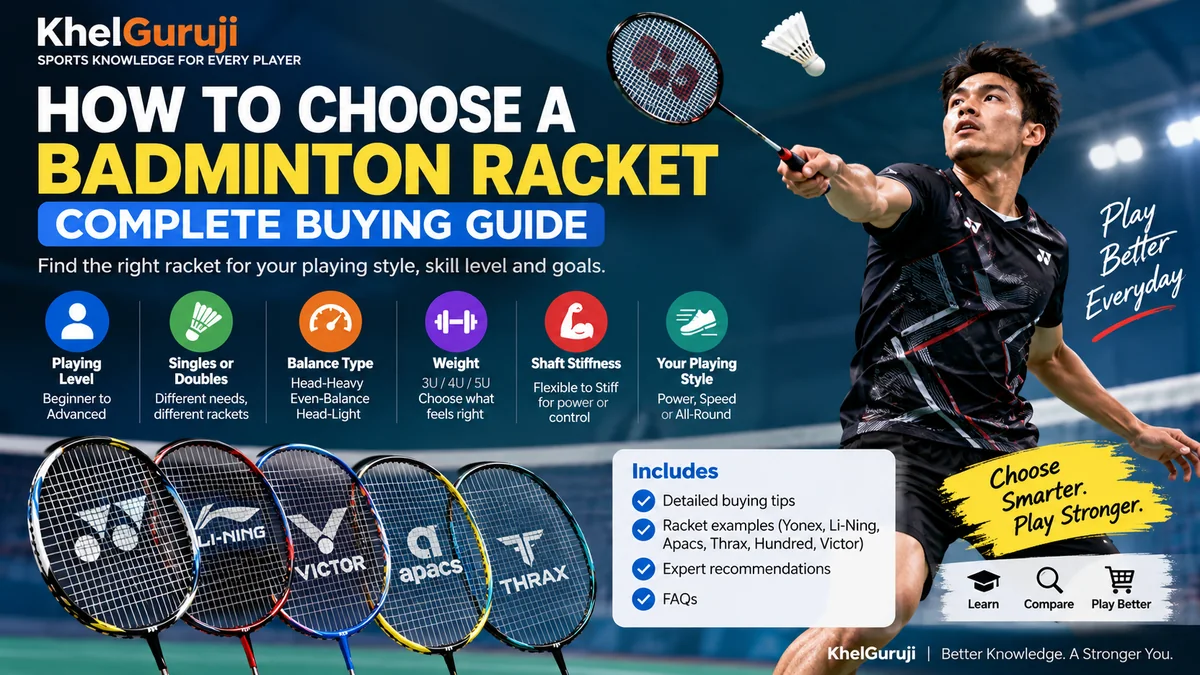
1. Why Choosing the Right Racket Matters
A racket that matches your body and playing style can make movement feel more natural. The goal is not to manufacture power by buying a particular model; it is to choose equipment that lets you use your technique efficiently.
- Better manoeuvrability: the racket can be easier to prepare during fast rallies.
- More effective attacking strokes: suitable mass distribution can help you transfer momentum through the shuttle.
- Improved control: a suitable shaft and string setup can make timing and placement feel more predictable.
- Less unnecessary fatigue: a racket that is too heavy or demanding may tire the arm during long sessions.
- More confidence: a predictable racket lets you focus on footwork, timing and shot selection.
2. Badminton Racket Weight: 3U, 4U and 5U
The “U” system describes a racket's weight class. Exact ranges can vary by brand and model, and published specifications may refer to unstrung weight. Always verify the manufacturer's specification.
| Class | Typical range | Feel | Often considered by |
|---|---|---|---|
| 3U | About 85–89 g | More mass and stability; generally slower than lighter alternatives | Strong players, singles players, players who like a solid feel |
| 4U | About 80–84 g | Good compromise between stability and manoeuvrability | All-round players and many doubles/singles players |
| 5U | About 75–79 g | Quick and easy to move, with less overall mass | Fast doubles, defence, juniors or players preferring lighter rackets |
3. Head-Heavy, Even-Balance or Head-Light?
The balance point describes where the racket's mass is concentrated. The illustrations below are conceptual: the dot represents where more of the racket's weight is perceived.
Head-Heavy
More mass toward the head. This can increase momentum through smashes and clears but may require more strength to change direction quickly.
Attack • rear court • singlesEven-Balance
A more neutral distribution. It aims to combine usable power, handling and control without strongly favouring one extreme.
All-round • mixed playHead-Light
Less mass is felt toward the head. The racket is generally easier to reposition for defence, drives and rapid doubles exchanges.
Speed • defence • doubles4. Power Rackets vs Speed Rackets — What's the Difference?
“Power” and “speed” are useful shorthand, but they describe different design priorities. Your technique remains the largest contributor to both shuttle speed and consistency.
⚡ Power-oriented racket
- Usually head-heavy or moderately head-heavy.
- More rotational mass can help carry momentum through the shuttle.
- Often suits players with complete swings and good preparation.
- Can feel slower during rapid defensive changes.
- Commonly preferred for rear-court attack and singles.
💨 Speed-oriented racket
- Usually lighter, head-light or designed for low aerodynamic drag.
- Faster to prepare and reposition.
- Useful for drives, interceptions and defensive reactions.
- Popular in fast doubles exchanges.
- May provide less “weight behind the shot” than a heavier head-heavy setup.
5. Shaft Flexibility: Flexible, Medium or Stiff?
| Shaft | General behaviour | Who may prefer it |
|---|---|---|
| Flexible | Bends more easily and can be forgiving for slower swings. | Beginners, recreational players and players with smoother/slower swing speeds. |
| Medium | Middle ground between assistance and direct response. | A broad range of intermediate and all-round players. |
| Stiff | More direct response but generally requires better timing and faster acceleration. | Technically developed players with fast, consistent swings. |
A common mistake is buying the stiffest racket because it is marketed as “professional.” If you cannot load and release a stiff shaft efficiently, the racket may actually feel less powerful.
6. Choose According to Your Playing Style
| Your priority | Starting point to consider | Why |
|---|---|---|
| Strong smash / rear-court attack | Head-heavy, 3U or 4U, medium-stiff/stiff depending on technique | More head mass can support attacking momentum. |
| Fast doubles / front court | 4U or 5U, even to head-light | Quicker preparation for interceptions and drives. |
| Defensive player | 4U/5U, head-light or fast-frame design | Easier racket repositioning during rapid defence. |
| All-round player | 4U, even or slightly head-heavy, medium stiffness | Balances attack, defence and handling. |
| Beginner | Manageable 4U/5U, even balance, flexible/medium shaft | Generally easier to learn with than an extreme setup. |
7. Racket Examples by Brand and Balance Type
Below are model families/examples to investigate, not a claim that every version has identical balance. Manufacturers release multiple generations, weights and regional variants, so check the current model's official specification before buying.
Yonex
Power / head-heavy families: ASTROX series, including models such as ASTROX 99, ASTROX 100 and ASTROX 88D variants.
Speed / head-light or fast-handling families: NANOFLARE series, including NANOFLARE 800 and NANOFLARE 1000 families.
All-round / balanced direction: ARCSABER family, including ARCSABER 7 and ARCSABER 11 variants.
Li-Ning
Power-oriented: Axforce family, including Axforce 80/90/100 variants depending on generation.
Fast-handling: BladeX and Wind-series models are worth comparing when speed and manoeuvrability are priorities.
All-round: Halbertec family contains models positioned toward controlled/all-round performance.
Victor
Power-oriented: Thruster (TK) series is Victor's well-known attacking family.
Speed-oriented: Auraspeed (ARS) series focuses strongly on speed and handling.
Control/all-round: DriveX (DX) series is commonly positioned around control and versatile performance.
Apacs
Apacs has a large catalogue with specifications varying considerably between markets. Popular performance families include Z-Ziggler, Virtuoso Performance, Lethal and Feather Weight models. Compare the exact published balance point, weight and stiffness rather than choosing only by series name.
Hundred
Hundred offers multiple performance lines aimed at attacking, speed and all-round players. Because its catalogue evolves quickly, compare the current racket's balance description, weight class and shaft stiffness on the official specification rather than assuming every model in a family has the same characteristics.
Thrax
Thrax also offers rackets across attacking, lightweight and all-round categories. For selection, use the model's actual balance point, weight, shaft flexibility and supported tension as the deciding specifications.
8. String Tension Changes How the Racket Feels
The racket and strings work as one system. Higher tension creates a firmer stringbed and can provide a precise response for players who consistently hit the sweet spot, while moderate/lower tension is generally more forgiving.
- Developing players: usually benefit from a forgiving setup rather than chasing very high tension.
- Intermediate players: can gradually tune tension according to feel, control and technique.
- Advanced players: may use higher tensions when their timing and contact are sufficiently consistent.
Always stay within the manufacturer's supported tension for your exact racket.
9. Grip Size and Final Setup
Grip thickness changes control and finger movement. Remember that replacement grips, overgrips, strings and protective tape also change the racket's final weight and balance. Two identical bare rackets can therefore feel different after setup.
10. Final Racket Selection Checklist
- Singles, doubles or both?
- Attack, defence, speed or all-round style?
- 3U, 4U or 5U weight preference?
- Head-heavy, even-balance or head-light?
- Flexible, medium or stiff shaft?
- Can your swing speed comfortably use that stiffness?
- What grip size feels natural?
- What tension does the manufacturer support?
- Will strings and grips materially change the final feel?
- Have you checked the exact specification of the model and weight variant?
Frequently Asked Questions
Which badminton racket balance is best for powerful smashes?
Head-heavy rackets are commonly chosen for attacking play because more mass is concentrated toward the head. That can help momentum, but good technique, timing and racket-head acceleration remain essential.
Which racket is better for fast doubles?
Many doubles players prefer 4U or 5U rackets with even or head-light balance because they are easier to reposition during drives, interceptions and defence.
Is 3U more powerful than 4U?
3U has more total mass, which can contribute to momentum, but it is not automatically more powerful for every player. A player who swings a 4U racket faster and times it better may produce stronger shots.
Is a stiff racket better?
Not universally. Stiff shafts tend to suit players with fast, technically consistent swings. A medium or flexible shaft may perform better for a player who cannot efficiently load a stiff shaft.
Which is better: head-heavy or head-light?
Neither is inherently better. Head-heavy prioritises attacking momentum, while head-light prioritises manoeuvrability. Even-balance sits between the two.
Should a beginner buy an expensive professional racket?
Price is not the main criterion. A manageable weight, forgiving shaft and suitable balance are more important than buying the most advanced model.
Sources & Specification References
General racket-selection principles and specification examples in this guide were cross-checked against manufacturer guidance. Exact specifications can vary by model and market.
- Li-Ning India — Racket Buying Guide — balance point and shaft-flexibility guidance.
- Li-Ning India — Rackets Weight Guide — 2U/3U/4U/5U/6U weight guidance.
- VICTOR Badminton — HX-020 specifications — manufacturer example showing weight, grip size, string tension and stiffness fields.
Still Unsure Which Racket Suits You?
Your ideal racket depends on your playing level, singles/doubles preference, swing speed and style. Use KhelGuru AI to explore those factors together.
Ask KhelGuru AI →Comments & Questions
Have a question or suggestion about this guide? Comments are published only after moderation.
Specification note: Product families and model examples are provided for educational comparison. Racket specifications, availability, naming and weight variants can change. Verify the exact current model with the manufacturer's published information before purchase.
Loading comments...