How to Measure Badminton Racket Swing Speed with Video & KhelGuru AI
Racket swing speed describes how quickly the racket is moving during a stroke. With a clear side-view video and a known scale for calibration, video analysis can estimate racket motion without specialist motion-capture equipment. KhelGuru’s Swing Speed tool is designed to make that process simple: upload a swing video, choose a calibration method and analyse the swing.
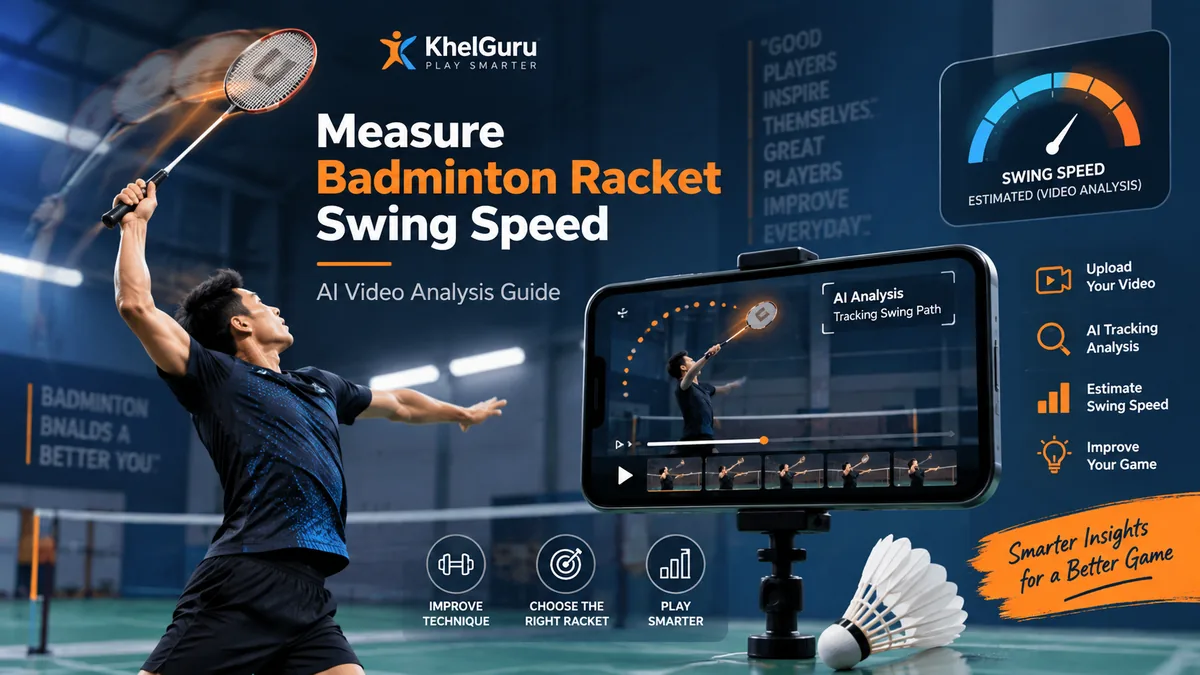
KhelGuru guide to recording and analysing badminton racket swing speed from video.
What Is Badminton Racket Swing Speed?
In practical terms, swing speed is the speed of the racket as it travels through the stroke. The value depends on where on the racket the motion is tracked and when in the stroke it is measured. Peak racket speed is therefore different from shuttle speed after impact.
This distinction matters. Research using high-speed motion analysis shows that badminton strokes happen very quickly and that fine racket trajectories can be difficult to reconstruct with ordinary frame-based video when motion blur is high. That is why recording quality and calibration matter when you use a consumer video for an estimate.
How to Record a Swing for Better Measurement
Keep the complete racket visible
Frame the player generously enough that the racket head does not leave the video near the fastest part of the swing. Avoid zooming or panning during the stroke.
Use the highest practical frame rate
Fast racket motion can cover a large distance between frames. If your phone offers a higher-frame-rate video mode with adequate image quality and lighting, it can provide more temporal samples of the swing. Do not sacrifice so much light that the racket becomes a blurred streak.
Use a calibration reference
A video contains pixels, not centimetres. To estimate real-world speed, the analysis needs a scale. KhelGuru’s interface offers an A4 calibration option for better accuracy and an estimated option that assumes a 67 cm racket length. The 67 cm setting is an assumption used by the tool, not a statement that every badminton racket is exactly 67 cm.
How to Use the KhelGuru AI Racket Swing Speed Tool
- Open KhelGuru Racket Swing Speed.
- Read the Better Accuracy Guidelines before recording or uploading.
- Choose your racket swing video. The current interface accepts MP4, MOV and M4V formats.
- Select the calibration method. Use the better-calibrated option when you have recorded the required reference correctly; otherwise the tool provides an estimated mode.
- Select Analyze Swing and review the estimated peak swing speed.
Measure your racket swing speed
Already have a clear side-view badminton swing video? Try the KhelGuru AI tool and get an estimated peak racket swing speed.
Open Swing Speed Tool7 Things That Can Change the Result
| Factor | Why it matters | What to do |
|---|---|---|
| Camera angle | A diagonal view can shorten the apparent path. | Record as close to side-on as practical. |
| Camera movement | Moving the phone changes pixel positions independently of the racket. | Keep the camera fixed. |
| Frame rate | Very fast movement may occur between frames. | Use a suitable higher-frame-rate mode when available. |
| Motion blur | A blurred racket head is harder to locate consistently. | Use strong, even lighting. |
| Calibration | An incorrect pixel-to-distance scale changes the speed estimate. | Use a known reference correctly. |
| Perspective | Objects at different distances from the camera have different apparent sizes. | Keep reference and swing plane reasonably aligned. |
| Different stroke | A clear, smash, drive and defensive swing are different actions. | Compare the same stroke type under similar conditions. |
How Should You Compare Swing-Speed Results?
The most useful comparison is usually you versus yourself under repeatable conditions. Use the same phone, camera position, calibration method, stroke type and similar warm-up state. Record several good attempts rather than drawing a conclusion from one swing.
Do not treat swing speed alone as a complete measure of badminton performance. Timing, racket-face orientation, impact location and control also influence the shot. Research on elite badminton smashes has shown that racket-shuttle impact location is related to post-impact shuttle speed and direction, illustrating why a faster swing does not automatically mean a better shot.
Swing Speed and Racket Choice
Racket characteristics can change how quickly a racket feels to accelerate and recover, but swing speed should not be used in isolation to select equipment. Balance, overall weight, shaft stiffness, technique and player preference all matter. For a broader selection framework, read our complete guide to choosing a badminton racket.
For an example of how speed, recovery and attacking response can be discussed in a specific racket review, see the Yonex Astrox 100 ZZ VA review.
Common Measurement Mistakes
- Recording from the front instead of a useful side view.
- Letting the racket head leave the frame at peak speed.
- Using a dark court where the racket becomes heavily blurred.
- Moving or zooming the camera during the swing.
- Using a calibration object far in front of or behind the swing plane.
- Comparing different stroke types as though they were identical tests.
- Treating a video estimate as laboratory-grade motion capture.
Frequently Asked Questions
Can I measure badminton racket swing speed with a phone?
Yes, video can be used to estimate motion when the racket path is visible and the video is properly scaled. Accuracy depends on camera angle, frame rate, blur, calibration and the analysis method.
What video angle should I use?
A clear side view is generally the most useful for the KhelGuru tool. Keep the camera fixed and position it so the main racket path is visible with minimal perspective distortion.
Why does KhelGuru offer A4 calibration?
A known-size object provides a real-world scale for the video. The KhelGuru interface recommends A4 calibration for better accuracy.
Is racket swing speed the same as shuttle speed?
No. Racket swing speed describes racket motion; shuttle speed is the shuttle’s speed after or around impact. Impact location, racket orientation, strings and the collision itself also affect shuttle behaviour.
Can I compare two badminton rackets using this tool?
You can make a more meaningful comparison by keeping the player, stroke, camera, calibration and recording conditions as consistent as possible and repeating several swings with each racket. The result should still be treated as a video-based estimate.
Sources & References
- Scientific Reports (2026) — fine reconstruction of badminton swing dynamic trajectory using event-camera-assisted analysis
- Journal of Sports Sciences — racket-shuttlecock impact location and shot outcome in elite badminton smashes
- KhelGuru AI — Racket Swing Speed tool and recording/calibration guidance
KhelGuru Swing Speed provides a video-based estimate. It is intended as a practical analysis aid and should not be presented as equivalent to laboratory-grade 3D motion capture or a calibrated high-speed measurement system.
Comments & Questions
Have a question about measuring badminton racket swing speed? Comments are published only after moderation.