BADMINTON TRAINING GUIDE
How to Improve Badminton Smash Power: Technique, Drills & Racket Setup
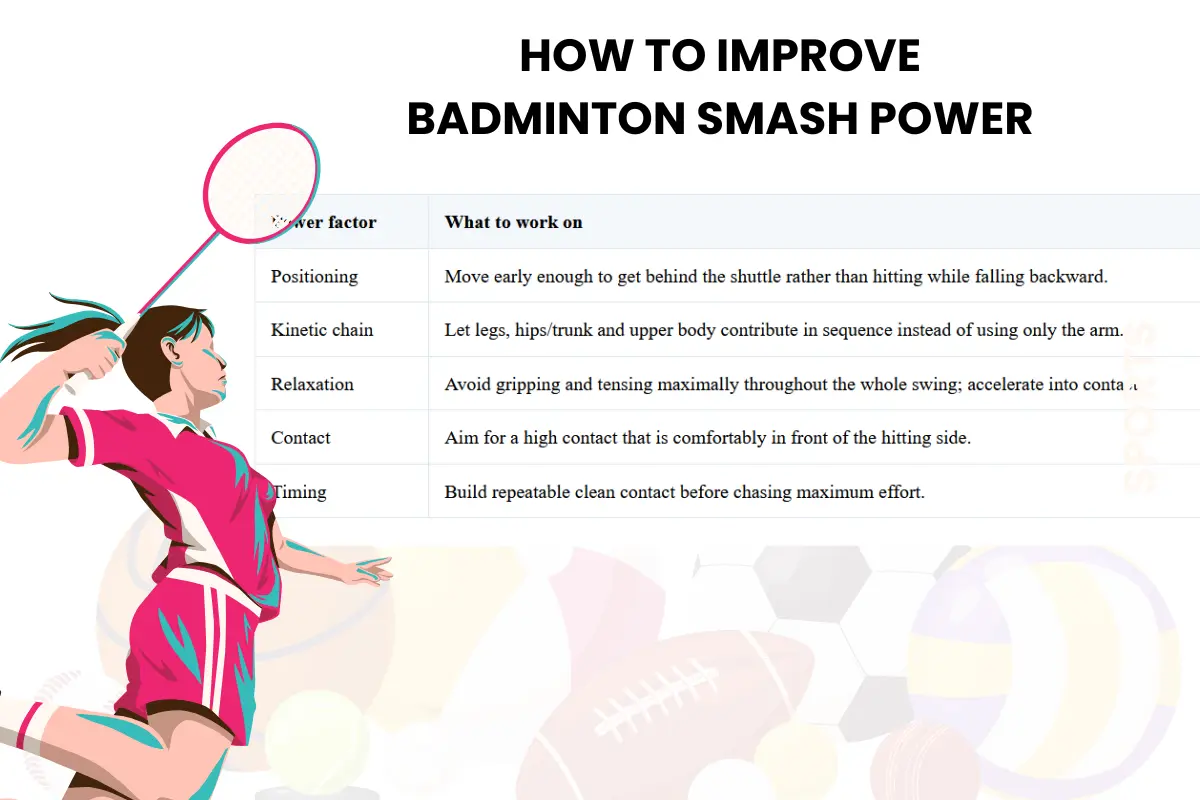
A harder smash usually comes from better positioning, timing and racket-head acceleration — not simply trying to swing your arm harder.
A harder smash usually comes from better positioning, timing and racket-head acceleration — not simply trying to swing your arm harder.
A badminton smash is a linked movement, not an isolated wrist action. Biomechanical research describes sequential contribution from the lower body and trunk into the shoulder, elbow/forearm and racket. Skilled players also show different shoulder, elbow and wrist kinetics from less-skilled players.
Body position matters before the swing even starts. Research comparing skilled and novice players found that positioning relative to the incoming shuttle influences smash quality. In practical terms, a technically good swing becomes much harder to use when you are late, cramped or reaching behind your body.
| Power factor | What to work on |
|---|---|
| Positioning | Move early enough to get behind the shuttle rather than hitting while falling backward. |
| Kinetic chain | Let legs, hips/trunk and upper body contribute in sequence instead of using only the arm. |
| Relaxation | Avoid gripping and tensing maximally throughout the whole swing; accelerate into contact. |
| Contact | Aim for a high contact that is comfortably in front of the hitting side. |
| Timing | Build repeatable clean contact before chasing maximum effort. |
If the shuttle is already behind you, your body has less room to rotate and accelerate naturally. Practise the movement to the rear court as part of the smash, not as a separate skill.
A useful preparation creates space for trunk and shoulder rotation. The exact position varies by player and situation, but the goal is to avoid a cramped arm-only swing.
Think of the stroke as a chain. The body begins the action and the faster distal segments follow. Research on overhead forehand smashes describes a whip-like sequence and coordinated joint rotations rather than one joint producing all the speed.
Trying to squeeze the grip and contract everything from the start often makes the stroke feel forceful without making it efficient. Use a controlled preparation and a sharper acceleration into impact.
A clean contact point gives the racket room to accelerate and helps produce a useful downward trajectory. Older biomechanical analysis of national-calibre players reported impact slightly forward of the body’s centre of gravity and highlighted shoulder and forearm rotation as important contributors.
A match-quality smash is not only powerful; it must allow you to recover for the next shot. Practise landing, balance and the first recovery step rather than admiring the shuttle.
When I explain smash-power practice, I prefer a simple progression rather than telling a player to hit every shuttle at 100% effort. Start with an easy feed and use roughly controlled effort while checking three things: am I behind the shuttle, is contact clean, and does the swing flow through the body rather than only the arm?
Once those three points become repeatable, increase pace gradually. If the player becomes late, loses balance or starts muscling the racket, reduce the pace again. The purpose of this example is not to claim a measured speed gain; it is a practical way to make technique remain stable as effort increases.
Without a shuttle, rehearse preparation, body rotation, overhead acceleration and recovery. Begin slowly enough to keep the movement smooth. This is for sequencing, not maximum-speed air swings.
Ask a feeder to provide comfortable high shuttles. Concentrate on moving behind the shuttle and contacting it in front. Hit at moderate effort until the contact becomes consistent.
Hit a small series at controlled effort, then medium-fast, then near match intensity while trying to preserve the same preparation and contact. If technique collapses at the highest level, return to the previous level.
Smash from the rear court, recover toward base, then respond to a second feed. This prevents training a smash that works only when you can stop after the shot.
Choose large target zones such as straight, body and cross-court areas. Produce a clean smash into the chosen zone before increasing speed. Match pressure rewards a smash you can direct, not only one that sounds loud.
Technical efficiency and physical capacity support each other. General lower-body strength, trunk control and upper-body strength can help a player create and tolerate explosive movement, but badminton-specific programming should match age, training history and coaching context.
For power work, quality matters more than exhausting repetitions. Explosive exercises are normally most useful when technique is sound and fatigue is controlled. Younger players and beginners should prioritise movement quality and qualified supervision rather than copying advanced loading.
Do not choose a racket by the word “power” alone. A head-heavy balance places relatively more mass toward the racket head and is commonly chosen by players who want more momentum through attacking strokes. The trade-off is that it can feel slower in defence and rapid exchanges, especially if the overall racket or swing weight is too demanding for the player.
A head-light racket is usually easier to manoeuvre quickly, but it does not automatically make a player weak at smashing. A fast, technically efficient player can still produce a strong smash. An even-balance setup can be a sensible middle ground when you want attack without making the racket excessively demanding.
| Balance type | Typical feel | Consider it if... |
|---|---|---|
| Head-heavy | More mass sensation toward the head | You have sufficient technique/strength and prioritise rear-court attack. |
| Even balance | More neutral distribution | You want a blend of attack, drives and defence. |
| Head-light | Quicker manoeuvrability | You value fast handling and generate racket-head speed comfortably. |
Weight class, shaft stiffness, strings, tension, grip build-up and the player’s own swing also change the final feel. Use the KhelGuru badminton racket selection guide or KhelGuru AI to narrow the profile instead of assuming one balance suits everyone.
| 4 min | Dynamic warm-up and relaxed overhead shadow movement. |
|---|---|
| 4 min | High-feed contact drill at controlled pace. |
| 4 min | Three-level acceleration drill. |
| 4 min | Smash, recover and second-shot drill. |
| 4 min | Placement targets, finishing with technically clean rather than exhausted repetitions. |
This is an illustrative practice structure, not a universal prescription. Adjust volume to your age, conditioning, training schedule and coaching plan.
Common reasons include late positioning, poor contact, an arm-dominant swing, excessive tension and mistimed acceleration. Start by improving clean contact and movement behind the shuttle before adding effort.
The wrist is only one part of the stroke. Research on smash biomechanics supports coordinated contribution from multiple body segments, with shoulder and forearm rotation playing important roles.
No. Head-heavy balance can add a stronger head-mass sensation, but technique, swing speed, overall racket weight, stiffness and timing all matter. Choose a balance you can accelerate repeatedly.
No. A jump smash adds movement and timing demands. Develop a reliable overhead smash and good positioning first, then add jumping when it suits the rally and your technique.
Track clean-contact percentage, depth/angle, placement, balance after the hit and video consistency. Speed is useful only when measured consistently; do not judge improvement only by sound.
Subham Sarkar is a sports knowledge and equipment-guide contributor at KhelGuru. He writes practical sports guides and equipment content with the player’s point of view in mind.
Comments
What helped improve your badminton smash? Share your experience. Comments are moderated before publication.