Quick take: The Nanoflare 1000 Z is a fast, head-light and extra-stiff racket aimed at players who can generate acceleration themselves. Its strongest identity is not effortless heavy-headed power; it is rapid racket preparation, crisp repulsion and the ability to turn short swings into aggressive drives, interceptions and counter-attacks.
Review method: This is a player-style performance assessment built from Yonex’s current specifications and documented racket design. The court-performance sections explain how those characteristics translate into practical play. They are not instrumented KhelGuru laboratory measurements, and no shuttle-speed or power figures are invented.
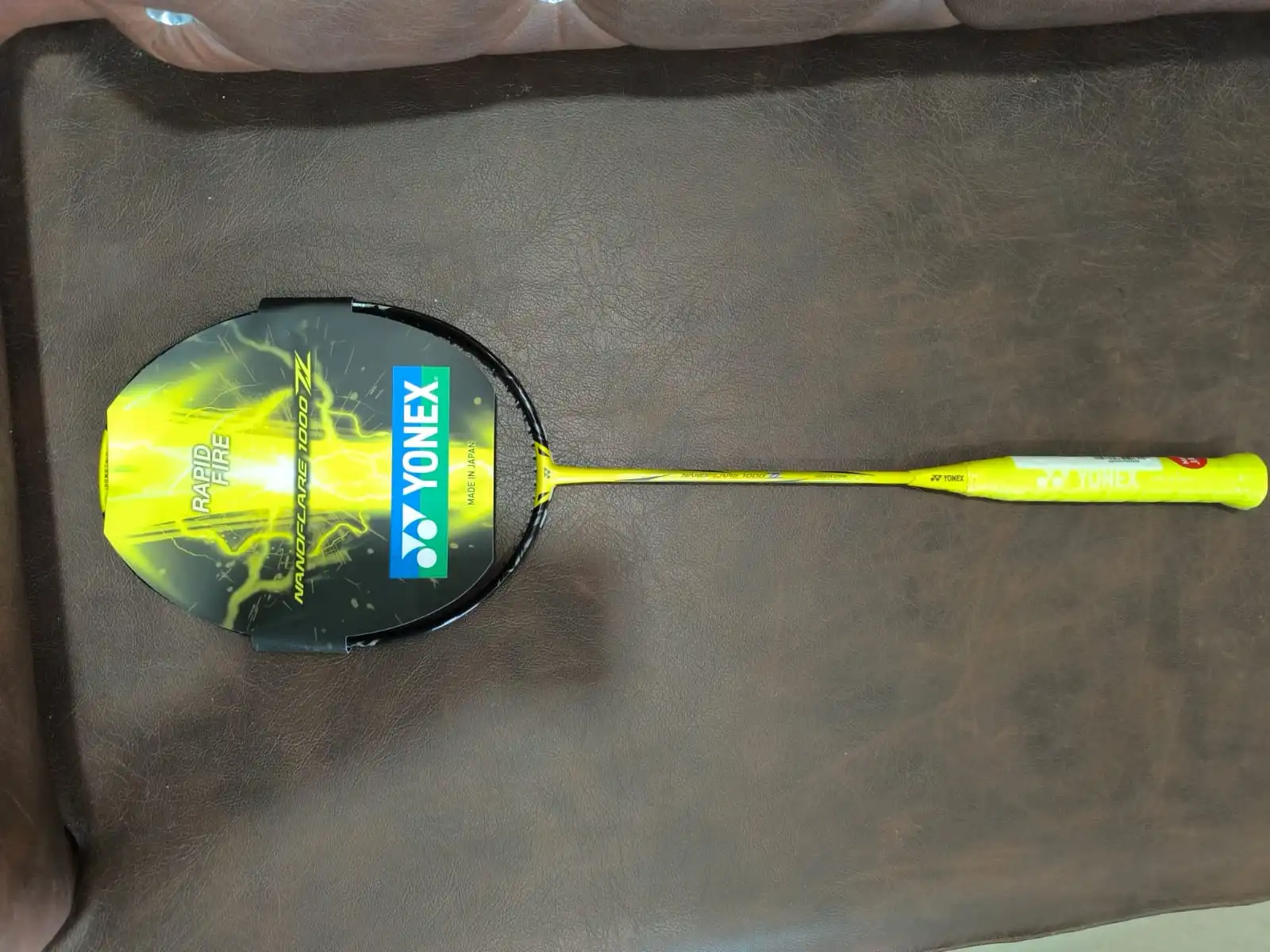
Current Yonex Nanoflare 1000 Z specifications
| Balance / performance identity | Head light / speed-oriented |
|---|
| Flex | Extra stiff |
|---|
| Frame | HM Graphite + NANOMETRIC DR + M40X + EX-HYPER MG |
|---|
| Shaft | HM Graphite + Ultra PE Fiber |
|---|
| Joint | NEW Built-in T-Joint |
|---|
| Length | 10 mm longer |
|---|
| Weight / grip | 4U (Avg. 83 g) G5,6; 3U (Avg. 88 g) G4,5,6 |
|---|
| Stringing advice | 4U: 20–28 lbs; 3U: 21–29 lbs |
|---|
| Recommended strings | Control: AEROBITE; hard hitters: EXBOLT 65 |
|---|
| Colour | Lightning Yellow |
|---|
| Item code | NF-1000Z |
|---|
These specifications come from Yonex’s current product page and 2026 badminton catalogue. Weight/grip availability can vary by market, so check the exact racket you are buying before choosing strings or tension.
What makes the 1000 Z different from a typical head-light racket?
Head-light normally suggests easy handling, but the 1000 Z combines that fast balance with an extra-stiff shaft and a compact, aerodynamically shaped frame. That combination makes it more demanding than the words “head light” may suggest. The racket is designed to move quickly, but the player still has to load it with clean acceleration.
Yonex describes the AERO COMPACT frame as a combination of a wide profile, aero shape and compact frame. The company also uses its Sonic Flare System, M40X and EX-HYPER MG materials, plus a SPEED-ASSIST BUMPER intended to limit frame deformation and support repulsion. These are manufacturer design claims; the practical value depends on the player’s swing and contact quality.
Player feel: very quick preparation, very direct response
The clearest playing characteristic is how quickly the racket can be prepared for the next shot. In flat doubles exchanges, the head-light balance helps with repeated forehand-backhand transitions, while the stiff shaft keeps the response direct rather than soft or delayed.
That directness has a trade-off. When contact is clean, the 1000 Z feels precise and lively. When timing is late or the swing is passive, the extra-stiff shaft offers less help than a medium-flex racket. This is why it makes more sense for technically settled players than for someone expecting the racket to create length automatically.
If you want to examine your own acceleration rather than guessing from labels, KhelGuru’s guide to measuring badminton racket swing speed from video provides a useful framework.
Smash test: speed-led attack rather than head-heavy momentum
The 1000 Z can be an aggressive racket, but its attack is different from a strongly head-heavy frame. The player supplies the acceleration; the racket’s fast handling and stiff response then favour a sharp, immediate hit. Full smashes reward clean timing, while stick smashes, half-smashes and fast follow-up attacks suit the racket particularly well.
For doubles, the more important advantage may be the second and third attacking shot. A racket that recovers quickly can help the player stay on top of a fast exchange instead of treating every attack as one maximum swing.
Players comparing this speed-first concept with Yonex’s power-focused flagship can read our Yonex Astrox 100 ZZ VA player review. The two rackets ask different questions of the swing even though both target advanced performance.
For a broader look at Yonex’s current elite-player product direction and signature equipment, see the Yonex Viktor Axelsen Collection 2026–2027 guide.
Back-court test: clears, steep attack and late contact
From the rear court, a strong player can use the 10 mm longer build and fast head movement to create penetrating clears and quick changes between clear, drop and smash. The 1000 Z feels most convincing when the player gets behind the shuttle and accelerates decisively through contact.
The harder test is a late clear. Because the shaft is extra stiff, players who rely on shaft flex to rescue weak preparation may find deep length more demanding. That does not make the racket weak; it means its performance is tied more closely to timing and racket-head speed.
For singles players who build rallies from the rear court, test repeatability rather than one impressive smash: deep clear, fast drop, punch clear, straight smash and recovery. A racket should still work when the rally has already taken speed out of your legs and shoulder.
Drives, defence, interceptions and net play
Flat drives and counter-attacks
This is the environment that best explains the Nanoflare 1000 Z. Short preparation, quick changes of direction and compact counter-drives benefit from a head-light racket that does not feel slow around the body. The extra-stiff response suits players who like a crisp hit rather than a pronounced shaft kick.
Defence
In fast defence, 4U will generally be easier to reposition than 3U, although grip build-up, strings and individual strength can change the final feel. The racket’s speed helps with blocks and drives, but defensive length still depends on getting clean contact; stiffness does not forgive poor timing.
Net and front court
At the net, the light head is useful for interceptions, pushes and quick changes between showing a block and punching the shuttle into space. Touch itself is not created by the balance point, so string choice and technique remain important.
1000 Z vs 1000 Tour, Game and Play
| Model | Flex | Position in the family | Practical distinction |
|---|
| 1000 Z | Extra stiff | Flagship / advanced | Highest-spec materials, compact speed frame, demanding direct response |
| 1000 Tour | Extra stiff | Advanced alternative | Similar speed concept with a different material construction |
| 1000 Game | Medium | Intermediate-oriented | More flexible response and simpler construction |
| 1000 Play | Medium | Entry into the 1000 design family | Graphite construction with the broad speed concept at a lower tier |
Do not assume the four rackets feel identical because they share the Lightning Yellow design language. Yonex lists meaningful differences in flex, materials and technology. Buy by the exact model code, not only by appearance.
Strings, tension and shuttle choice
Yonex currently recommends AEROBITE for control players and EXBOLT 65 for hard hitters on the 1000 Z. The listed tension range is 20–28 lbs for 4U and 21–29 lbs for 3U. Those are equipment limits/advice, not a recommendation that every player should use the top number.
A very stiff racket combined with unnecessarily high tension can make off-centre contact less forgiving. Choose tension around your technique and usual shuttle, not around what a professional player uses. Shuttle construction also changes timing and feel; see KhelGuru’s nylon vs feather shuttlecock guide.
Current player-equipment context
Yonex continues to document the NANOFLARE 1000 Z in elite competition. Its 2026 Thomas & Uber Cup equipment report listed Weng Hong Yang with the model, and a September 2026 Yonex tournament report listed Tomoka Miyazaki with it. This is useful evidence that the racket remains current at top-level competition, but professional equipment choice should not be treated as a recommendation for every player.
The model was also used in Yonex’s April 2023 Guinness World Records attempts by Satwiksairaj Rankireddy and Pearly Tan. Those measured shuttle-speed records were produced under a specific controlled record attempt; they should not be interpreted as a promise that a buyer will reproduce those speeds.
Who should choose the Nanoflare 1000 Z?
The strongest match is an intermediate-to-advanced or advanced player with established timing who values racket-head speed, drives, interceptions, defence and fast attacking combinations. It can suit doubles especially well, while a singles player can also benefit if they generate their own rear-court pace and prefer a fast head over heavy momentum.
It is less logical for a developing player who needs a flexible shaft to help create easy length, or for someone whose main preference is the planted, head-heavy sensation of a power racket.
Practical buying checklist
- Confirm the racket is the NF-1000Z, not Tour, Game or Play.
- Choose 3U or 4U based on your strength and event rather than assuming lighter is always better.
- Test late back-court clears as well as smashes; stiffness becomes obvious when preparation is compromised.
- Test rapid drive-to-defence transitions to see whether the head-light balance genuinely helps your game.
- Use a sensible tension within Yonex’s range and your own technical level.
- Verify market-specific grip/weight availability and authenticity before purchase.
Where it fits beside other Yonex performance rackets
The 1000 Z makes sense when speed is the starting point. A player who wants more obvious head-weight assistance may be better served by investigating an Astrox-type profile, while a player prioritising hold and directional control may prefer an Arcsaber-style profile. These are design directions, not universal rankings.
For more context around Yonex’s current player and equipment ecosystem, see the Yonex Viktor Axelsen Collection 2026–2027 guide.
Overall performance impression
The Nanoflare 1000 Z is distinctive because its speed does not come from a soft, easy-flex setup. Yonex combines a head-light identity with an extra-stiff shaft and compact aerodynamic frame, producing a racket that wants fast hands and committed acceleration.
For the right player, that translates into quick preparation, crisp drives, aggressive interceptions, sharp counter-attacks and rapid recovery after an attacking stroke. The cost of that directness is forgiveness: if your timing is inconsistent or you want the shaft to help create easy rear-court length, the 1000 Z can feel demanding.
Frequently asked questions
Is the Nanoflare 1000 Z head heavy?
No. Yonex identifies the 1000 Z as a head-light, speed-oriented racket.
Is the Nanoflare 1000 Z stiff?
Yes. Yonex lists the flex as extra stiff, which makes clean timing and player-generated acceleration important.
What tension can the Nanoflare 1000 Z take?
Yonex currently lists 20–28 lbs for 4U and 21–29 lbs for 3U. Always verify the exact racket before stringing.
Should I choose 3U or 4U?
There is no universal answer. 4U reduces overall mass and is often easier in rapid exchanges; 3U adds mass. Your strength, event, grip setup and timing matter.
Is it only for doubles?
No. Its speed characteristics are highly relevant to doubles, but singles players who generate their own pace and prefer a fast head can also use the design effectively.
Is the 1000 Z the same as the 1000 Tour?
No. They share the Nanoflare 1000 performance concept, but Yonex lists different material constructions. Verify the exact model code before buying.
Related KhelGuru guides
Sources & Specification References
About the Author
Subham Sarkar is a traveller, athlete, sports writer and equipment reviewer at KhelGuru. He writes practical sports guides and equipment reviews with the player’s point of view in mind.
Comments
Have you used the Nanoflare 1000 Z? Share your experience. Comments are moderated before publication.